

The Difference Between a Designer and a Strategic Designer
There’s a version of this job where you open the brief, pick up the prompt, and start making things look good. All the technical boxes are checked: the typography is considered, the color palette is intentional, and the layout breathes. You send it over, and it’s genuinely beautiful. Job well done.
And then nothing happens. The client loves it, but the rebrand doesn’t move the needle. The website launches, and the conversions don’t shift. The campaign runs, and nobody feels anything, and the content numbers flop on social. You scratch your head, wondering what happened??
Your work was beautiful, but it would benefit from a stronger strategy.
What a Strategic Designer Does Differently
When a non-strategic designer gets a brief, they read it, start culling images, search for the perfect font, and create layouts in Illustrator. When a strategic designer gets a brief, they read it and start asking questions.
This is not a stall tactic or a way to “actively procrastinate”. It’s a way to stop and think, “What is the problem that needs to be solved here?” And if you think the brief is the problem, you’re wrong. The brief is someone’s best attempt at describing the problem. Those are two very different things.
A strategic designer looks at who the client is, what the market looks like, who their audience actually is (not who the client thinks they are), where this brand sits relative to its competitors, and what success would genuinely look like in six months. They do the research. They sit with the context. And then and only then do they open a file.
Here’s the encouraging bit: this is not meant to stifle your beautiful Type B artistic energy or creative exploration. Digging into strategy is not a special talent reserved for people who work at big agencies with strategy departments. It’s a practice, a muscle that can be exercised. And the reason it feels unfamiliar to so many designers is that nobody taught it to us how to use it.
It was the foundation of my design education, actually—one of the things that my design school got deeply right. Before we ever sketched anything, we had to know why. We had to be able to defend every decision, trace it back to a real insight, a real human need, a real problem we were solving. That discipline has never left me. And the further I’ve gotten in my career, the more I’ve realized how rare it actually is.
The Questions a Strategic Designer Asks Before Opening a File
If you want to start thinking more strategically, start here. These are the questions worth sitting with before a single pixel gets placed (Tip: save this image for reference):
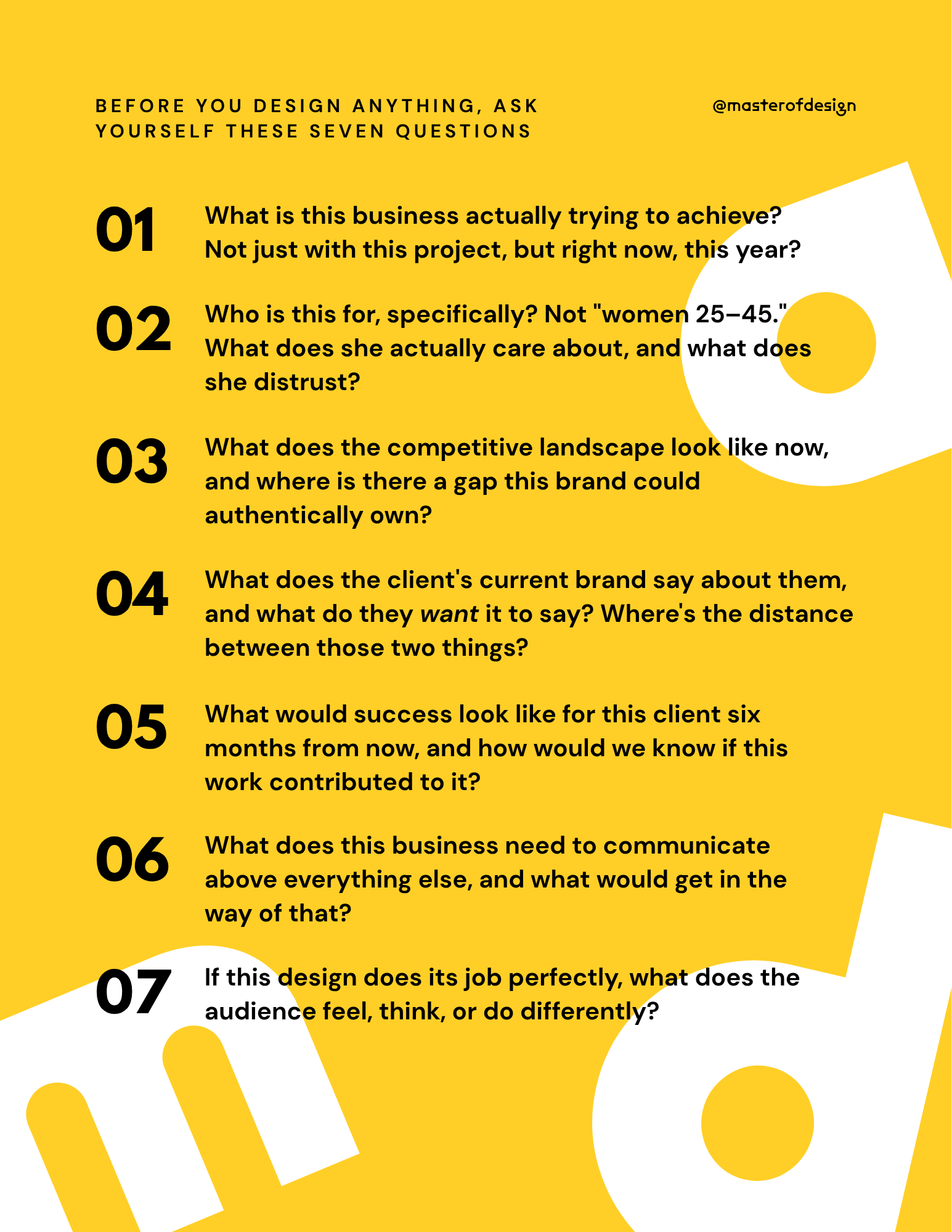
Don’t think of these as intake form questions. They're thinking tools. You might not ask all of them in a client meeting (we’ll get to that in a later class), but you should be able to answer all of them before you start designing. If you can't, you're not ready to open the file yet.
You’re Probably Already Doing Some of This
Here’s what I want you to know: if you’ve ever pushed back on a client’s brief because something felt off, you were thinking strategically. If you’ve ever asked a client what their competitor is doing before you started, you were thinking strategically. If you’ve ever questioned whether a logo color actually fits the audience (even just in your head), you were thinking strategically.
You just might not have had language for it. Or a framework that validated it as part of the job.
Strategy isn’t a separate discipline that lives above design. It’s the thinking that makes design work. And the designers who build it into their process, even imperfectly, produce work that doesn’t just look right on launch day but still makes sense two years later. That’s a job well done.
A design with a strategic foundation makes the difference between a trend-forward piece and a timeless asset. The aesthetic might age either way. But the thinking underneath a strategically grounded brand doesn’t. Some of my favorite work is almost a decade old, but I know that the strategy behind the decisions still holds up.
Why This Changes Everything About Your Value
When you can walk a client through your thinking, articulating why each decision serves their actual business goal while showing them the work, something shifts. They stop seeing you as a vendor or executor and start seeing you as a partner. Your value just skyrocketed in their eyes.
That’s when the revision cycles get shorter. Say goodbye to scope creep. The client stops trying to art direct you and starts trusting that you understand what they’re trying to build.
And, good news, that's when you stop undercharging, because you can finally defend what you're selling. You’re not just one of a million designers selling pretty for the cheapest. Your value propositions shift to selling clarity, positioning, and a brand that actually works. That's a different conversation entirely and honestly, one that allows clients to breathe a sigh of relief, knowing that their brand (their baby) is in good hands.
Class Dismissed.
Homework: Practice Explaining Your Thinking Out Loud
Strategic design is a muscle, and like any muscle, it develops through use. One of the fastest ways to build it? Talking through your decisions with other designers who get it.
Inside The Collective, we do exactly that: design exercises, critiques, and real conversations about the thinking behind the work, not just the work itself. If you’ve been making beautiful things but struggling to explain why they’re the right solution, this is the room for you. Bring your work. Bring your questions. Start practicing. I promise I’ll be kind in my critique.
