

Positioning in Plain English

A client comes to you. They’ve got the idea, they’ve got the business credit card, and they are READY. They want a logo. They want colors. They want the whole kit and caboodle. And you’re excited too, because the concept is genuinely cool and you can already see where you’d take it visually.
But here’s the thing nobody told them (and honestly, nobody told most of us either): before a single design decision gets made, there’s a question that needs an answer.
Where does this brand live in the market, and why does it live there instead of somewhere else?
That, my friends, is a little secret called positioning. And once you understand it, you can’t un-see it. You’ll start noticing when it’s missing in every brand you encounter. You’ll start defending your design decisions with something more solid than intuition. And your clients will feel the difference in every presentation you give them.
So what is positioning, actually?
Here’s my plain English version: positioning is about owning a specific place in your customer’s mind. This is not what your product does, but what it means relative to everything else they could choose instead.
It’s not a tagline. It’s definitely not a vibe. It’s the strategic answer to: Why this brand, over that one? Why now? And in a world where we have a million things vying for our attention, the answer to this question is what makes or breaks brands.
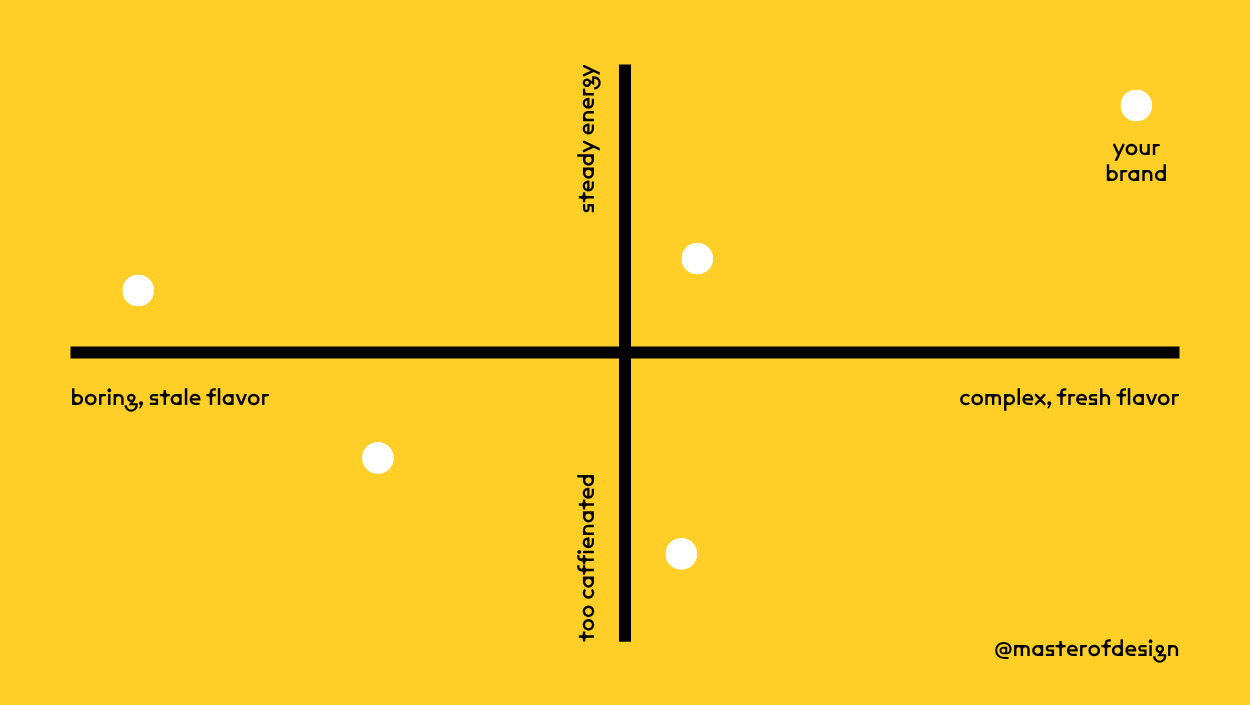
A helpful way to visualize it: picture a simple XY chart (chill out…this is as math-y as it gets). You place your competitors on it. The axes represent the qualities that actually matter to your target customer. Let’s say you’re building a canned espresso brand. One axis runs from “too caffeinated” to “steady energy.” The other runs from “boring, stale flavor” to “complex, fresh flavor.” You plot your competitors. Most of them cluster somewhere in the middle or toward the lower left.
The goal? Your brand lives in the top right.
That open space, the place no one else is occupying, is called white space. And finding it is the whole game. Positioning is the art of planting your flag there and building everything around it.
The four things that make up a position
When you’re doing this work with a client, here’s what you’re actually trying to figure out:
Mental real estate. Where does this brand live in the customer’s head? Features and specs are forgettable. Feelings and associations are not. A brand that owns a clear mental space is one people reach for without thinking too hard. That’s the goal, baby.
Differentiation. What is this brand doing that no one else is doing, or doing it in a way no one else does? This isn’t about being different for the sake of being interesting. It’s about being different in a way that’s relevant to the people you’re trying to reach.
Targeting. Who, specifically, is this for? (More on this in a minute, because this is where designers can add enormous value and it’s wildly underused.)
Strategic foundation. Positioning is the North Star. It guides every marketing decision, every copy choice, every visual direction. When a brand’s positioning is clear, the creative brief basically writes itself. When it isn’t, you’re guessing from the jump.
How we actually get there
This is where the strategy session earns its place in the process. I never, ever skip it. (We’ve talked about this before. If you missed it, go back and read the piece on what actually happens in a strategy call before you open Illustrator.)
For newer brands, especially, positioning isn’t something clients walk in knowing. They’ve got the idea. They know what they’re selling. But the competitive landscape, the white space, the differentiation story? That’s something we often build together.
I take them through it in a specific order. First, the nuts and bolts: Who are your competitors? What are they doing well? Where are they falling short? What does the landscape actually look like when you map it out? This is where the XY chart earns its keep. Putting a client’s concept on a chart next to their competitors makes the white space visible in a way no amount of conversation can replicate. (At the end of the day, we all love a visual.)
Then we get to the question of differentiation: What are you doing that they’re not? What’s the thing you do, say, offer, or embody that nobody else on that chart can claim?
That’s the USP—the unique selling proposition. And it needs to be authentic. Not aspirational in a way that’s actually just wishful thinking, but true. Something the brand can genuinely own.
Now for the part I love most: the brand muse
Once the positioning is clear, we move into the muse. And here I want to be very precise about something, because this is not the same thing as a persona or a psychographic profile.
A persona is a person who might buy from you. It’s demographic. It’s useful. But it’s not this.
A brand muse is the person who inspires every decision you make in the business. She’s aspirational. She’s specific. She’s real enough in your mind that you can ask yourself, at any point in the creative process: would she actually want this?
When I’m building a muse with a client, we get specific. Not “women aged 25-40 in urban markets.” No. What does she talk like? How does she get to work? Does she take the metro, or is she the kind of person who stress-drives with her coffee balanced on the roof of the car? Is she a morning person, or does she hit snooze until the last possible second? How does she talk to her friends? Is she close with her family? What does she do on a Saturday afternoon when she has nowhere to be?
THAT level of specificity is what makes a brand muse useful. Because when you know her that well, every decision—the typeface, the tone of voice, the copy, the color story, the kind of content you make—has a reference point.
The reason I love this exercise so much is what it does to the positioning work that came before it. All of the strategic thinking (the competitive landscape, the white space, the USP, the differentiation story) lives inside this person. She’s the human embodiment of the brand’s position.
And here’s the counterintuitive part: being specific about who your muse is does not shrink your market. It expands it.
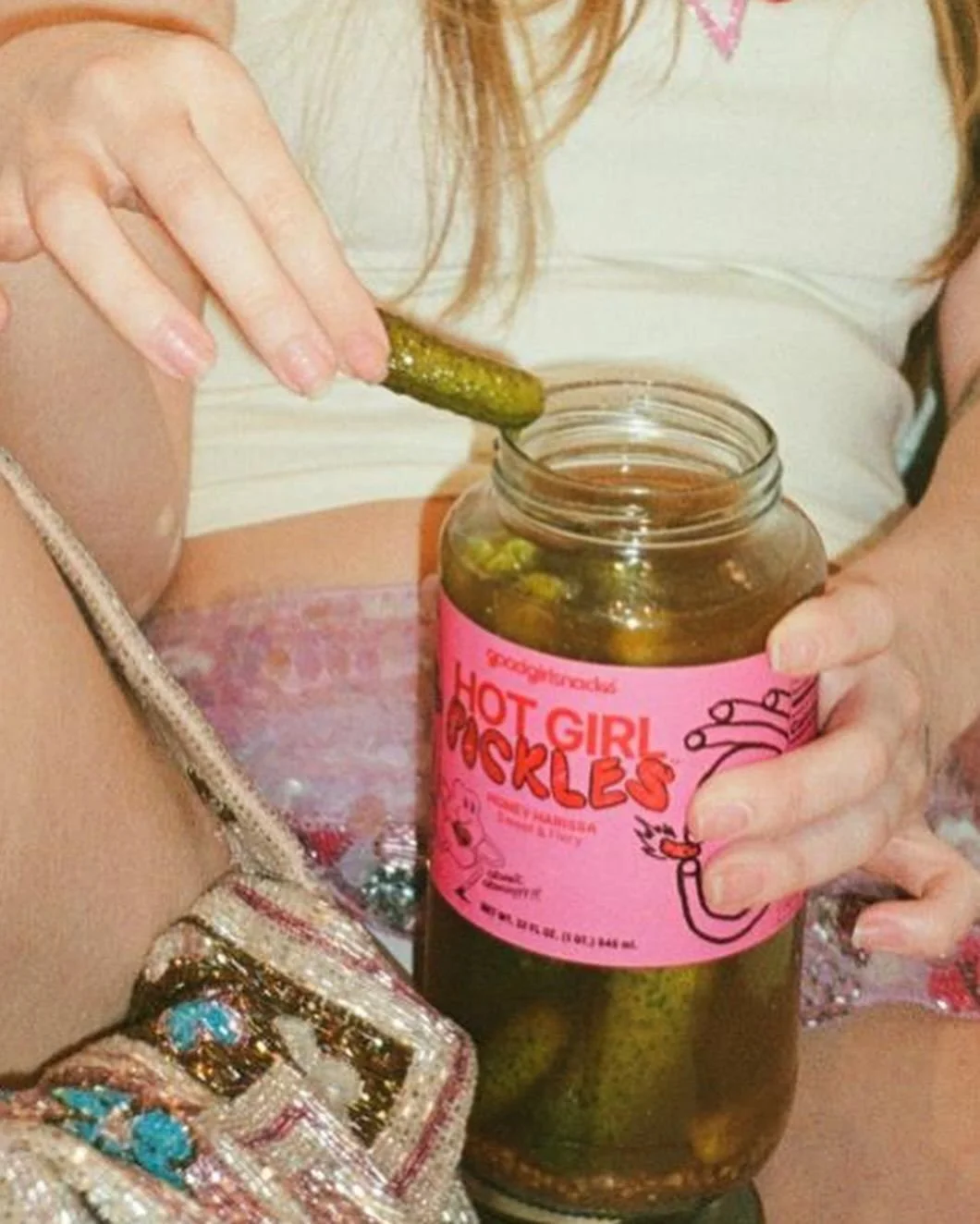
Hot Girl Pickles is one of my favorite examples of this in the wild. Their muse is impossibly specific. She’s the trendy, bubbly party girl who loves a dinnertime martini, hot gossip with her girls, and has strong opinions about fashion. She’s fun. She’s a little chaotic. She is her. And because of that specificity, the brand has a point of view so clear and so magnetic that people who are nothing like her still reach for the jar. A midwestern mom doing her weekly Whole Foods run picks them over Clausen because the brand has an energy she finds delightful. Aspirational isn’t about being the muse. It’s about being drawn to what the muse represents.
Specificity creates desire. Vagueness creates forgettability.
Read: ‘Hot’ and ‘Girl’ are not necessary descriptors to enjoy a Hot Girl Pickle
Why this is a designer’s superpower
Here’s what positioning gives you that no moodboard, no trend report, and no amount of good taste can give you: the ability to defend your work.
When you’ve done this thinking with your client, when you’ve mapped the competitive landscape together, found the white space, defined the muse, every design decision you make has a reason that goes beyond “It felt right.” You can say: our muse doesn’t do fussy, so this wordmark needed to feel effortless. You can say: this color lives in the white space we identified. Nobody else in this category is doing warm and grounded, and that’s the point.
That’s a story. And clients don’t just approve stories; they feel proud of them.
The best part? This is not a skill only strategists get to have. This is yours. Every brand designer who learns to think this way becomes exponentially harder to replace, harder to lowball, and more effective in every room they walk into.
Positioning is how you stop decorating and start building.
Class dismissed.
Inside The Collective, we work through positioning frameworks in real time, including how to run the XY chart exercise with actual clients and how to facilitate a brand muse session that goes somewhere.
