

Presenting Doesn't Have to Be Scary
I used to walk into (or set up my laptop for) client presentations the same way I walked into critiques in school: heart rate up, palms doing what palms do, mentally rehearsing every decision I’d made so I could defend it the second someone squinted at the screen. I was 22, I looked 12, and I was trying to convince a 35-year-old business owner that what I’d built for them was something they could actually hinge their entire brand identity on. The gap between what I knew I could do and what I felt confident saying out loud was enormous. Insert article about imposter syndrome [here].
The anxiety wasn’t really about the work. Looking back, I knew the work was good (and I’m still proud of many of those early projects). The anxiety was more about what it meant if they didn’t like it. Every presentation felt like a verdict on my design career: A yes meant I was ready. A no meant I wasn’t. I’d collapsed the whole thing into a referendum on whether or not I belonged in the room.
That’s an exhausting way to present. And it’s also, as it turns out, completely avoidable. Lemme share my secrets for making presenting waaaay less scary (and, dare I say, fun??)
The shift that changed everything for me wasn’t a technique; it was a reframe.
I stopped thinking about design as a product I was delivering and started thinking about it as a service I was providing. And that distinction matters more than it sounds. When design is a product, the presentation is a transaction. “Here’s the thing I made, do you like it???” But when design is a service, then the presentation is a conversation. “Here’s what I understood about your problem, here’s how I solved it, let’s talk about whether this is the right path forward.” Totally different.
The relationship and the communication aren’t secondary to the work. In many ways, they are the work. A great solution presented badly is a lost client. A confident, clear walkthrough of a strong direction is how trust gets built. And trust is what actually closes projects (and speeds up edit rounds).
Most designers I know are introverted by nature. They do their best thinking alone, in silence, deep in a file. The idea of performing in front of a client feels completely foreign to everything that drew them to design in the first place. I get that. What I’d push back on is the word “performing.” You’re not performing. You’re having a conversation with someone who hired you because they believe you can solve a problem they can’t solve themselves, and they believe in your work. That’s not a stage. That’s a peer relationship where you happen to have the expertise.
Once I started showing up that way, the whole thing changed.
Here’s something most people don’t talk about: the presentation doesn’t actually start when you open the deck. It starts weeks earlier, in the discovery call and the strategy session you had before you ever touched a file. This is one of the many reasons why having actual conversations with my clients is essential to my process.
Yes, those calls are important for deeply understanding the project brief and for building personas and brand muses, etc. But they also help establish a relationship with the client so that by the time I’m walking a client through a brand presentation, I already know how they communicate. I know whether they’re analytical or emotional, whether they process out loud or go quiet when they’re thinking, whether they use language precisely or loosely, whether they lead with gut reaction or need time to sit with something. I’ve been paying attention this whole time. And that information shapes how I (virtually) walk into the room.
This is one of the less visible benefits of a solid discovery process: it doesn’t just inform the work, it informs the relationship. You stop presenting to a stranger and start presenting to someone you’ve already started to understand. And oftentimes, by this stage in the game, they feel more like friends than “clients”.
Okay, what if you’re still thinking, “That’s great and all, but leading presentations is not something I want to hone in on.” For those designers reading this and still feeling the familiar dread of having to explain themselves in real time, I have a workaround I use regularly and am not even slightly embarrassed about.
Record a Loom video before the live call.
Before I get on a presentation call with a client, I record a full video walkthrough of both directions, flipping through every page, narrating every decision, explaining the thinking behind each solution in my own voice, at my own pace, without anyone asking questions I’m not ready for yet. Then, I send it to them before we meet.
This does a few things at once. One, it gives the client an artifact, something they can return to, pause, rewatch, share with a partner or spouse whose opinion matters to the decision. Two, it gives them context before we sit down together, so the live conversation is a reaction and a dialogue rather than a first impression. And honestly, three, it takes an enormous amount of pressure off the room. By the time we’re on the call, they’ve already processed the initial shock, excitement, or confusion. We get to skip straight to the actual conversation.
Recording a walkthrough video isn’t a crutch and your client won’t see this as cheating. Some of my best client conversations have happened because they came to the call having already watched the Loom twice, with specific questions, with a clear sense of what they were responding to. That’s not a shortcut; that’s efficiency and care working together. And oftentimes, they really appreciate this aspect of the process.
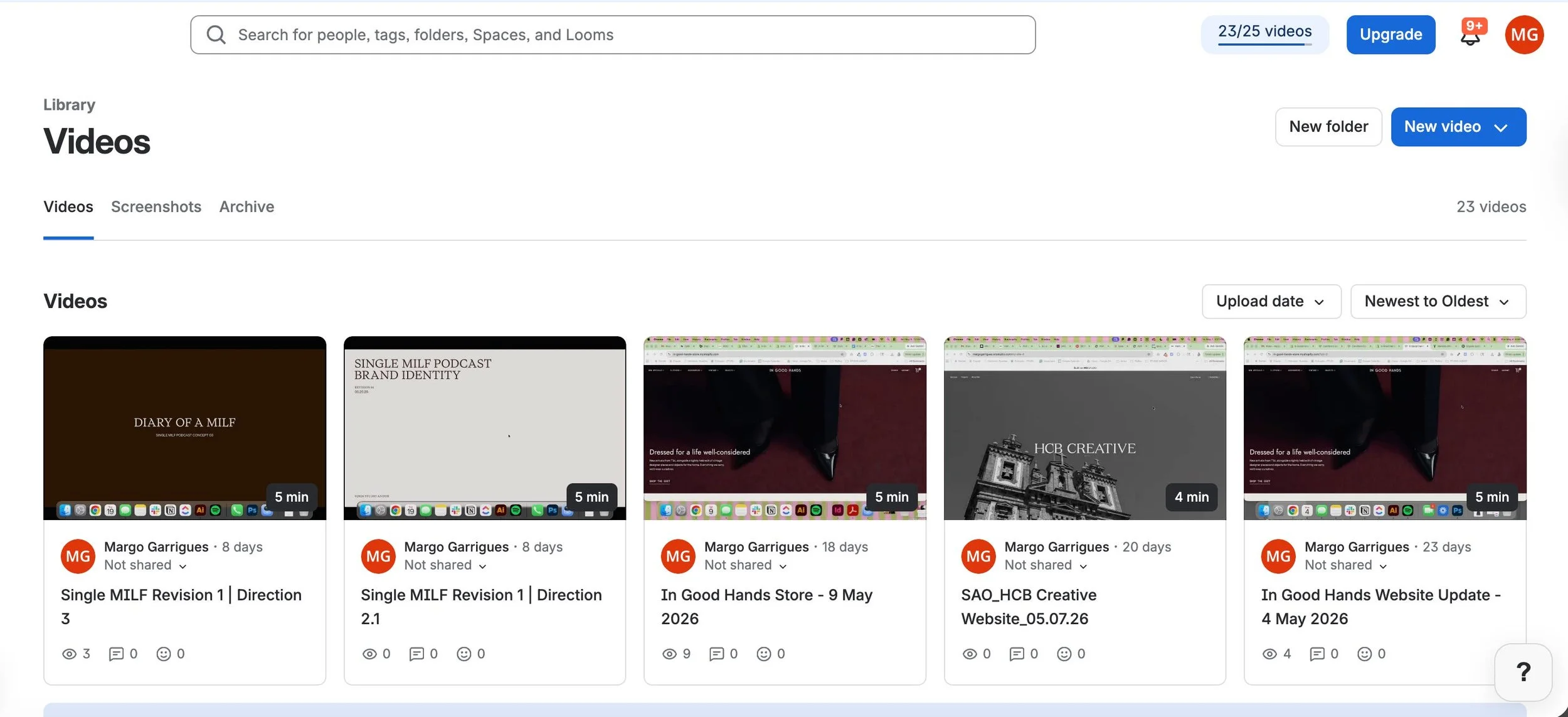
Long time lover of Loom videos
When it comes to the presentation itself, I present two directions. Always two.
I know there’s a whole school of thought that says present one thing, build the airtight case, show the single definitive solution, and defend it completely. I totally understand the logic. But in practice, one direction puts the client in a yes-or-no trap. And a no to the only option you’ve shown them makes the conversation much harder than it needs to be.
Two directions give your client something to decide on, which makes them feel like they have more agency in the process.
When a client can say, “We loved these three things about direction two and didn’t connect with these two things about direction one,” that’s a productive conversation. That’s data. That’s momentum! Compare that to “we’re not sure this is right” when there’s nothing else on the table to point toward. That begins the arduous task of working with them to determine why they didn’t really jive with it. By presenting two directions, you give them the agency of choosing something rather than rejecting something, and people are much better at saying yes than they are at articulating what’s missing.
I think about it like this: I’ve been developing a beverage recently, working with a formulator and receiving samples to respond to. And I’ve noticed that I don’t have the language to explain what I wish were different about a sample I don’t love (I just don’t have the deep vocabulary and understanding of subtle flavors and scents that I wish I did). But if I’m handed a second sample that has the quality I was reaching for, I can say immediately, “That’s it! Make it more like that one”. In the same vein, visually, clients work exactly the same way. They know what they like when they see it. Give them something to point to.
Both directions I present are fully realized: logos, wordmarks, color palette, typography system, illustration style, photography direction, mockups on packaging and signage and social and print. Two complete brand worlds that I could box up right after the call if they said yes. I’m not presenting just a logo or a sketch; I’m showing them whole worlds. Because when someone sees their name pressed onto the front of a box or set into a sign above a door, they start to believe it’s real. That belief is what moves a project forward.
A Walkthrough of the Client Presentation Call
Here’s how the actual call runs.
I open with a few minutes of genuine conversation. How’s the week going? What’s been on their mind? Something personal we’ve talked about before? This isn’t small talk as a formality; it’s intentional. It puts everyone at ease, signals that we’re peers in a conversation rather than a designer presenting to a client, and honestly, it usually gives me a last-minute read on where their head is before I share my screen. It also loosens me up because I would rather chat with a friend than present to a “client”.
Before I start walking through the work, I ask them to hold off on any reactions, good or bad, until the end. I don’t want someone falling in love with direction one before they’ve seen direction two, and I don’t want someone mentally picking apart a logo while I’m trying to walk them through the typography system. I want them to receive the whole thing first.
The walkthrough runs for about 20 to 30 minutes. I explain every decision. I note where things could expand or flex, so they understand what they’re seeing is a direction, not a locked final, but a clear and considered one (Don’t forget, we still have 2 rounds of revisions in the scope). Then, once the deck is done, I open the floor for open conversation. We go page by page, back and forth, wherever they want to linger. I let them drive and tell me all of their thoughts.
At the end of the call, I send them the deck and tell them not to get back to me for two to three days. Show it to one or two people whose opinions matter to the decision. Sleep on it. Let it warm up or cool down. I’m not trying to rush a yes. I’m trying to get the right yes. The clients who’ve had time to process, to sit with both directions, to start imagining how it lives in the world, those are the clients who come back to the follow-up call clear, decisive, and excited. That energy carries all the way through to the final files.
Five things that will make your next presentation better:
1. Build the relationship before you build the deck. Discovery is research for the relationship just as much as it is research for the work. In these sessions, clock how your client communicates before you’re in front of them with something to show.
2. Record the walkthrough before you go live. A Loom or Vimeo walkthrough sent before the call gives everyone space to process on their own terms. The live conversation becomes a dialogue instead of a debut.
3. Present two directions, not one. Give people something to choose, not just something to accept or reject. Having two fully realized brand worlds creates the conditions for a productive conversation.
4. Ask them to hold their reactions until the end. Let them receive the full presentation before they start reacting to any part of it. You’ll get cleaner, more considered feedback and a much better conversation.
5. Give them time after the call. Two to three days. No exceptions. The clients who’ve had time to sit with it come back with clarity. Clarity is what gets projects to final files.
Once you switch your mindset from presentations as some big, scary thing where you have to prove that you are a good listener and a good designer, to a conversation where you get to show off the work you created and open the floor for productive feedback, presenting becomes way less intimidating. And if all else fails, a video sent via email works just fine.
Class Dismissed.
