

Why Your First Idea Is Rarely the Right One (But Why You Need It Anyway)
I had a high school teacher who left a lasting impression on me (I literally was telling a friend about him this weekend; he was the kind of intentional, independent teacher I know I was lucky to have). I really liked him and still feel grateful for his influence.
One day, he gave us an exercise that seemed a little unconventional (to be fair, these kinds of lessons were not uncommon in his class): He told us to write down as many types of birds as we could in 30 seconds. Just birds. Whatever came to mind. Go!
Everyone’s page filled up quickly. Cardinals, robins, blue jays, blackbirds…probably the same kinds of birds you would have thought of while reading this. Then he called time.
And then he told us to keep going. Fifteen more seconds.
The second round was tougher. You could sense the room slow down as people started to dig deeper. With the obvious birds already listed, everyone had to really think and search their memory for less common ones. That’s when the more interesting answers appeared, with the ones that took a moment to recall. We’d moved on from crows and flamingos and penguins to shoebills and vulture guineafowl and marabou stork. (One kid in our class was an avid birdwatcher, so he put us all to shame).
Our teacher explained that your first answers are rarely your best. It’s because they’re just the easiest to reach. They’re familiar, safe, and right at the front of your mind. The good ideas, the ones unique to you, are further back. You only find them by sticking with the process a bit longer than feels comfortable (and maybe even further than that).
I did not think about that exercise again for probably fifteen years. And then I started noticing it everywhere in my own work.
The Attachment Problem
I have to admit, I get attached to my first ideas quickly. I’m decisive and antsy, and I oftentimes want to take an idea and run it to the moon. When a client describes their brand, their vibe, and their goals, something often clicks in my mind right away. It feels like a burst of inspiration, and I want to play with it immediately, building it out and falling in love with it before I’ve even checked if it’s the right fit.
The problem is that instant idea is almost always like the bird exercise. It’s Cardinal or Blue Jay tier. It’s the most obvious version of what I just heard, maybe with some design polish. It’s not necessarily wrong (they’re fine birds!), but it’s not the complete answer yet.
So I’ve had to create a habit to avoid this. If I didn’t, I’d keep refining that first idea endlessly and convince myself it was finished.
My approach is simple, but I stick to it: When I’m ready to work on a second concept, I open a completely new Illustrator file. I start fresh with a new mood board, new notes, and new sketches, with nothing carried over. If I can still see my previous work, I get stuck on it and end up making a slightly different version of the same idea instead of something truly new. I need a blank canvas, a tabula rasa. It’s the only way I’ve found to let myself think in a new direction.
THE HUB
The clearest example of this I can point to is a project I worked on earlier this spring, a brand identity design for a high-end fitness club opening on Johns Island.
When we first met the clients, they showed me interior renderings and a stack of inspiration images. The look was all about natural materials and colors, creating a space that felt serene and slightly feminine, but still strong. Clean and minimal. They were hesitant about other gym brands they’d seen that were dark and bold, brash and loud. That wasn’t how they wanted their space perceived at all, leaning more towards clean and invitational, a literal hub where people can work out and want to stay after with friends. For this reason, at first, they asked for no color in the brand whatsoever.
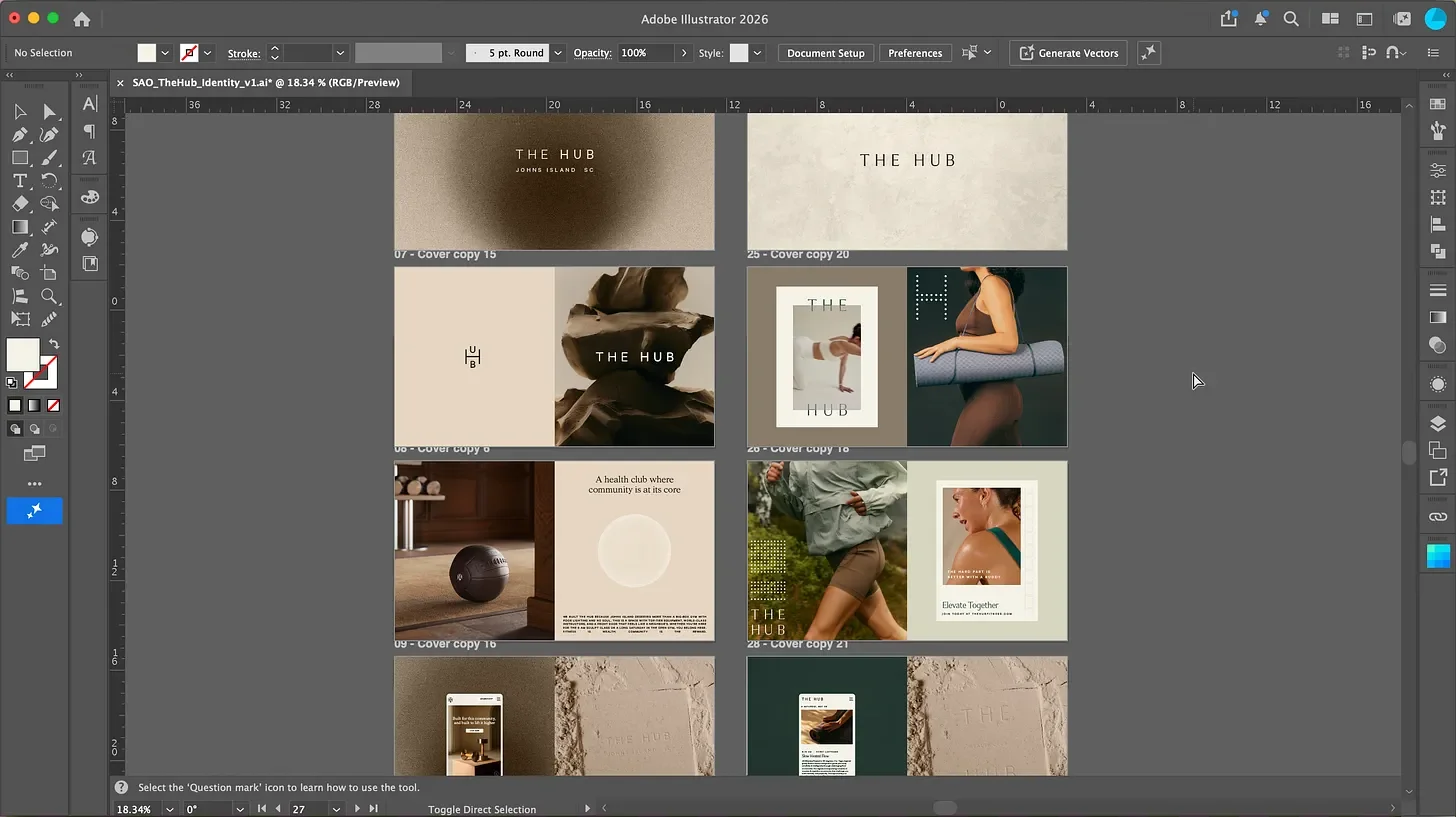
So that’s what I gave them for round one. Very clean, very minimal, built around scale and texture instead of color. Every shade of brown you could ask for, from a light beige all the way down to a deep cocoa.
It was good work, and I was deeply proud of it. But if I’m honest, it was the Cardinal—it was the safest and most literal interpretation of what they had described.
Before starting the second direction, I reviewed everything we had discussed and everything I knew about the space. The name is THE HUB, after all. They wanted a place where people could find community, not just focus on fitness, where you’d want to stay for a while, maybe grab a coffee or a beer with a friend after your workout. The words that kept coming up in our conversations were community, warmth, and familiarity.
I opened a new file and started with a blank canvas. This time, I focused less on the finishes in the renderings and more on how the space should feel for people actually spending time there.
The second direction kept the same sense of restraint, the same spaced-out type, and the same mix of thin and thick lettering. But I added a cool fern green and a color close to sea glass, a touch more life while keeping the overall aesthetic calm. I also used photography that felt personal: real people in deep teal workout clothes, golden tans, sweat, and big, genuine smiles. It was still aspirational, in that you’d want that life for yourself, but it was rooted in the idea that it’s better to work out together than alone.
When I showed both directions, the first felt elevated and solved the brief. But the second felt like the real space they wanted to create: joyful, intentional, and alive. That’s the one they picked, and it was an easy choice.
Not too dissimilar, but both concepts brought a different energy to them
When I Don’t Reset
I wish I could tell you I always catch myself in time, but I’m human and I don’t.
There have been plenty of times when I got lazy or too attached and pushed a first concept further than it deserved. Almost every time, if I look back, it’s for the same reason: I got excited about my own idea and stopped really listening to what the client had told me.
It’s not easy to admit, but I think most of us started this work because we care about our craft and want to make something we’re proud of. But sometimes that instinct turns into ego. I’ve had the embarrassing experience of sitting in a meeting and realizing, as I watched a client’s expression change, that I missed what they actually said. I came in with my own idea and confidence, trying to get them to love it, instead of doing the harder work of listening first and creating second.
That’s the side of the business that gives designers a bad reputation: the genius-with-a-vision act. It’s tempting, because sometimes your first idea really is good. But good isn’t the same as correct, and it’s your responsibility to know the difference before you present it as the solution.
Why the First Idea Isn’t Wrong, Just Incomplete
Don’t hear me say that you should burn every first idea that you have. I’ve honestly had some moments of clarity on the first try that really resonated with the client. And first ideas aren’t bad. You need them. They allow you to play and try and fail and dig deeper. The first idea comes when you take everything you just heard and translate it directly, without much filtering. It’s helpful because it clears the obvious answer out of your mind, making room to search for the idea that’s deeper, the one that takes more effort to find, and the one that’s truly specific to this client instead of just a reasonable guess.
Most of the time, I work through three or four directions on my own before choosing the two I refine and show to a client. That’s not being wasteful or inefficient; it’s the process working as it should.
And you never know, you might discover that your first idea truly was the right way to go.
Class Dismissed
Five Things I’ve Learned About First Ideas
1. Let the first idea happen. Don’t skip it or judge it too quickly. It’s not wasted time; it’s the version that needs to exist before the real one can appear.
2. Create a true blank slate for yourself. For me, that means starting a completely new file every time. Find whatever method works for you, but make it a must. You need real distance from your first concept to build the second one honestly.
3. Evaluate your first idea based on what you truly know. Before starting the second round, review your research, notes, and conversations. Ask yourself what’s still missing, not just what looks good. And ask yourself why you made those decisions. That can be just as revealing and lead you into new directions.
4. Know what to share and what to keep to yourself. Clients don’t need to see every idea you considered. Part of your job is understanding what helps them and what only satisfies your own attachment to your process.
5. Be careful of falling into the ego trap. If you notice yourself trying to persuade a client to love an idea instead of listening to whether it’s truly right, that’s your cue to pause. Go back to what they told you. The goal isn’t to be right; it’s to get to the right answer.
Class Dismissed.
